Why Cross™ Manifolds Use Less Energy, Install Faster and Eliminate Sticking Zone Valves
A different approach to hydronic zoning
The manifold is the control centre of a multi-zone hydronic heating system. It directs heated water to the rooms calling for heat and isolates the zones that have reached their set temperature.
The concept is simple, but conventional manifold systems can become unnecessarily complicated.
A typical multi-zone manifold uses a separate thermal actuator on every circuit. Each actuator requires wiring, consumes power while operating and depends on a small spring-loaded valve pin that may remain stationary for months at a time.
Over the life of the system, these components can become a source of slow operation, sticking valves, wiring problems and service calls.
The Cross™ Manifold was created to provide a simpler alternative.
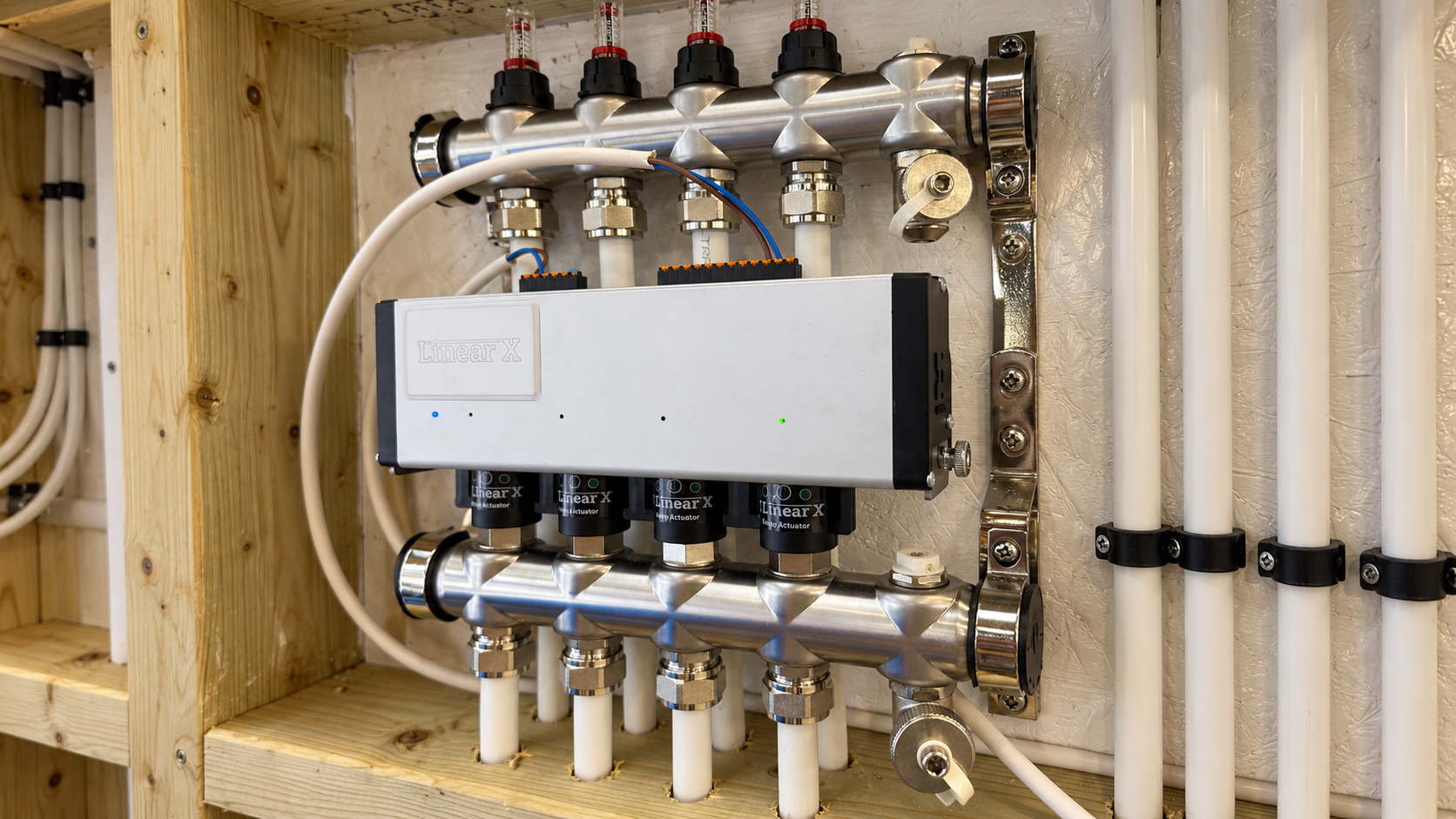
Cross combines the manifold, electronic zoning controls and motorized valve operation into one pre-assembled system. It is designed for fast installation, dependable room-by-room control and up to 99% less actuator energy consumption than conventional thermal actuators.
The Limitations of Conventional Thermal Actuators
Most conventional radiant manifolds use one thermal actuator for every heating circuit.
Inside each actuator is a small heating element. When a thermostat calls for heat, electricity warms the actuator, gradually expanding an internal material that pushes down on the manifold valve pin.
When the thermostat is satisfied, the heating element switches off and the actuator slowly cools. As it cools, the valve returns to its closed position.
This method has been widely used for years, but it has several disadvantages.
Continuous electrical consumption
A conventional thermal actuator generally requires electrical power for as long as its zone remains open.
In a large radiant heating system, several actuators may be energized simultaneously for many hours. Each actuator consumes only a modest amount of electricity, but the total increases when multiple actuators operate throughout an entire heating season.
Slow response
Thermal actuators do not open or close immediately.
They must first heat up, expand and move the valve pin. Closing also takes time because the actuator must cool before returning to its original position.
This delay may not prevent the system from operating, but it makes zoning less responsive and can complicate boiler, heat-pump and circulator control.
Multiple components and electrical connections
A twelve-zone manifold may require twelve individual thermal actuators, together with the corresponding wiring and control connections.
Every actuator and connection adds installation time and becomes another potential point requiring diagnosis or replacement later.
Sticking valve pins
Traditional manifolds commonly use small spring-loaded metal valve pins.
During the summer or other periods when heating is not required, these pins may remain stationary for months. Scale, corrosion, debris or seal resistance can cause the pin to stick when the system is restarted.
A thermostat may call for heat and the actuator may operate, but the valve beneath it may not open correctly.
Spring-loaded closing
Conventional zone valves often depend on spring force to close.
Rapid valve movement can contribute to hydraulic shock or water hammer, particularly when system flow is high. Repeated mechanical impact also places unnecessary stress on valves, pumps and connected components.
How Cross Works Differently
Cross replaces a bank of conventional thermal actuators with one integrated motorized control assembly.
The Cross platform uses two stepper motors with separate responsibilities:
- One motor positions the control mechanism at the required zone
- The second motor operates the selected valve
When a thermostat calls for heat, Cross identifies the required circuit, moves to the correct position and operates that valve. The system can then control the individual zones connected to the manifold according to thermostat demand.
Hall-effect position sensing allows the controller to monitor the mechanism’s position without depending on estimated travel time alone.
This creates a controlled mechanical zoning system rather than a collection of independent heating elements attached to spring-loaded pins.
Up to 99% Less Actuator Energy
One of the principal advantages of Cross is its low actuator energy consumption.
A conventional thermal actuator consumes electricity while it is being held open. If several zones remain active, several actuators may continue drawing power throughout that heating period.
Cross uses energy primarily when its motors need to reposition the mechanism or operate a valve. It does not require a separate continuously energized thermal actuator for every open zone.
This allows the Cross actuator system to consume up to 99% less energy than conventional thermal actuators.
It is important to understand what this claim means: it refers specifically to the electricity used for manifold actuation and zone control. The actual heating-energy consumption of the complete building still depends on factors such as insulation, outdoor temperature, heat source, water temperature, controls and occupant settings.
Nevertheless, eliminating the continuous electrical demand of multiple thermal actuators is a meaningful improvement—particularly in buildings with numerous heating zones.
Faster, Plug-and-Play Installation
A conventional manifold can require the installer to mount and wire an actuator for every circuit, connect those actuators to a wiring centre and then verify the operation of each zone.
Cross arrives as an integrated, pre-assembled zoning system.
This significantly reduces the work required on site. Instead of assembling a control system from numerous individual components, the installer connects the heating circuits, thermostats, power and system-control outputs.
The result is:
- Fewer individual components to mount
- Fewer electrical connections
- Less actuator wiring
- Faster commissioning
- Cleaner mechanical-room installations
- Easier troubleshooting
Cross is available for different electrical standards. North American configurations can integrate with 24-volt thermostats, while UK and European versions can operate with compatible 230-volt controls and volt-free thermostat contacts.
The specific wiring arrangement depends on the selected Cross model, but the principle remains the same: simplify installation by supplying the zoning system as a coordinated assembly.
Valves Designed Not to Stick
A zone-control system is only dependable if its valves continue to operate after long periods of inactivity.
Cross addresses this problem through both its valve construction and its electronic control.
PTFE valve stems
Cross uses 100% PTFE valve stems designed to move smoothly and resist the sticking problems associated with conventional metal valve pins.
PTFE has naturally low friction and does not corrode like exposed metal components. This makes it particularly well suited to a valve mechanism expected to operate reliably over many heating seasons.
Positive motorized operation
Instead of depending solely on a thermal actuator pressing against a small spring-loaded pin, Cross uses controlled motorized movement to operate each valve.
This provides deliberate opening and closing rather than relying on the expansion and cooling of a thermal element.
Reduced Risk of Water Hammer
Water hammer can occur when moving water is stopped too quickly.
Traditional spring-return valves may close abruptly, creating a pressure wave within the piping. Depending on the system design and flow rate, this can cause knocking sounds and place additional stress on hydronic components.
Cross uses controlled motorized valve movement instead of relying on a spring to snap the valve closed.
The motor operates the valve smoothly, reducing sudden changes in flow and helping minimize the conditions that contribute to water hammer.
This provides quieter operation while reducing unnecessary hydraulic shock within the system.
Dependable Room-by-Room Zoning
Cross is a zoning system—not an automatic flow-balancing system.
The manifold’s flow meters are used during commissioning to set the required flow through each circuit. Once the system has been properly balanced, Cross opens and closes the zones according to thermostat demand.
This distinction is important.
Cross does not continuously rebalance every heating circuit. Its purpose is to provide dependable zone control while simplifying the actuator and wiring arrangement normally required on a multi-zone manifold.
The operating sequence is straightforward:
1. A room thermostat calls for heat
The thermostat sends a demand signal to the Cross controller.
2. Cross identifies the required zone
The positioning motor moves the mechanism to the appropriate circuit.
3. The valve motor operates the zone
The selected valve opens in a controlled manner.
4. Heated water enters the circuit
The manifold directs flow through the corresponding heating loop.
5. The thermostat reaches its set temperature
Cross closes the zone in a controlled manner when heat is no longer required.
This allows each room or controlled area to respond independently without requiring a separate thermal actuator on every manifold port.
Fewer Components Mean Fewer Potential Failures
Traditional manifold assemblies can contain a large number of separate parts:
- Multiple thermal actuators
- Individual actuator cables
- Terminal connections
- A separate wiring centre
- Spring-loaded valve pins
- Additional relays or control components
Each part may be reliable on its own, but increasing the total component count also increases the number of potential failure points.
Cross simplifies the system by consolidating valve operation and zone control into one coordinated platform.
Fewer actuators and connections can mean:
- Less time spent diagnosing control faults
- Fewer replacement components
- Easier access during servicing
- Cleaner wiring
- More consistent zone operation
- Reduced long-term maintenance
If service is eventually required, the centralized design also makes the system easier to understand than an installation containing numerous separately wired actuators.
Faster Commissioning
Commissioning a conventional manifold requires more than filling and balancing the heating circuits.
The installer must also confirm that each thermostat is connected to the correct actuator, verify that every actuator opens and closes and ensure that the wiring centre correctly enables the heat source and circulator.
Cross reduces the number of separate devices that must be checked.
The installer can:
- Fill and purge the heating circuits
- Set the required circuit flow rates
- Connect the thermostats and system controls
- Confirm the identification of each zone
- Test valve operation through the integrated system
This more organized process can reduce commissioning time and make it easier to identify any wiring or circuit-assignment issue before the project is handed over.
Cleaner Mechanical Rooms
The mechanical room is often hidden from the homeowner, but its organization still matters.
A clean installation is easier to understand, commission and service. It also reflects the quality of the overall heating system.
By reducing the number of individual actuators and external wiring components, Cross creates a more streamlined manifold assembly.
The result is particularly valuable in projects where space is limited, including:
- Mechanical cupboards
- Apartment utility spaces
- Plant rooms
- Multi-manifold residential installations
- Renovations with limited service access
- Listed and heritage properties
The compact, integrated arrangement makes it easier to keep piping, wiring and controls organized.
Well Suited to Boilers and Heat Pumps
Cross can be used as the zoning platform for hydronic systems supplied by either boilers or heat pumps.
Its function remains the same regardless of the heat source: respond to thermostat demand and control the flow to individual heating zones.
This makes Cross suitable for:
- Radiant floor heating
- Ultra-Fin in-joist heating
- Wall-panel heating
- Low-temperature heat-pump systems
- Conventional boiler systems
- Mixed hydronic applications
Because the system provides straightforward zone control, it can form part of both new installations and carefully planned retrofit projects.
Designed to Work With Ultra-Fin
Cross and Ultra-Fin® are designed to work together as part of a complete hydronic heating platform.
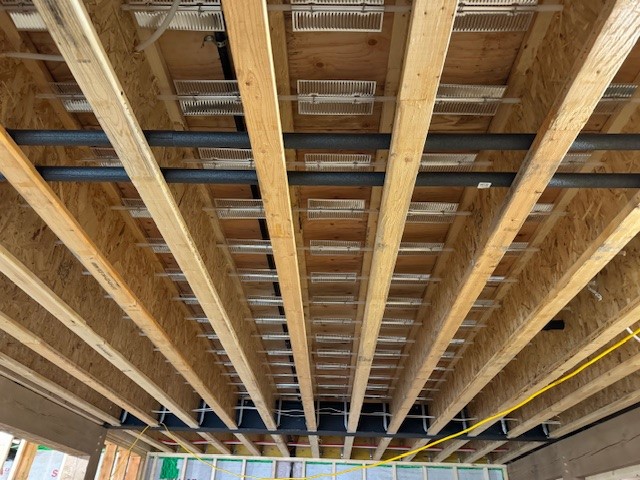
Ultra-Fin distributes warmth through the floor structure, while Cross controls which rooms receive heated water.
The complete process is simple:
1. The heat source warms the water
A boiler or heat pump supplies water to the system.
2. Thermostats monitor the individual rooms
Each zone calls for heat according to its temperature setting.
3. Cross controls the required circuits
The manifold directs flow to the zones requesting heat.
4. Ultra-Fin distributes the warmth
Tubing and Ultra-Fin heat emitters transfer heat through the floor structure.
5. The room reaches its desired temperature
Cross closes the zone when the thermostat is satisfied.
Together, the two systems provide radiant heat delivery and room-by-room zoning without unnecessary control complexity.
A Better Approach to Manifold Control
Cross does not attempt to reinvent hydronic heating. It improves one of the areas that has remained unnecessarily complicated: controlling multiple heating zones.
By replacing numerous continuously powered thermal actuators with one integrated motorized control assembly, Cross provides a simpler and more efficient approach.
The key benefits include:
- Up to 99% less actuator energy consumption
- Faster plug-and-play installation
- Fewer individual actuators and electrical connections
- PTFE valve stems designed to resist sticking
- Anti-jam functionality during periods of inactivity
- Controlled valve movement to help reduce water hammer
- Hall-effect position sensing
- Dependable room-by-room zoning
- Easier commissioning and servicing
- A cleaner, more organized manifold installation
For installers, this means less time assembling and wiring the system.
For building owners, it means fewer individual components, lower actuator-energy consumption and dependable control.
For occupants, it means something even more important: consistent comfort in every room.
Simpler by Design
The best mechanical systems are not necessarily the ones containing the most components. They are the ones that perform their intended function reliably while remaining straightforward to install, operate and maintain.
Cross was developed around that principle.
One integrated control platform replaces a row of individual thermal actuators. Controlled motorized movement replaces slow thermal expansion and spring-loaded closing. PTFE valve stems and anti-jam operation address the problem of sticking valves. Plug-and-play controls reduce installation and commissioning time.
The result is a manifold system designed not only to control hydronic zones, but to simplify the entire process surrounding them.